
Tirzepatide. Not only does it effectively manage type 2 diabetes, but it has also demonstrated “game-changing” potential in the field of weight loss. Did you know? The reason this once-weekly injection provides long-lasting effects lies in a sophisticated design that allows it to “travel” through the human body.
Today, we’ll take you through the entire process of absorption, distribution, metabolism, and excretion (ADME) of tirzepatide within the body after a single injection. Let’s explore how science enables this tiny molecule to precisely help you manage your blood sugar and lose weight.
I. The Starting Point: A Precise “Delivery” in a Single Injection
Unlike many medications that must be taken daily, Tirzepatide is designed for a once-weekly subcutaneous injection. This is made possible by its unique molecular structure—a long fatty acid chain attached to the GIP (glucose-dependent insulinotropic polypeptide) sequence.
To put it another way:
It’s like attaching an ultra-effective “freshness label” to a package. When injected under the skin (typically in the abdomen, thigh, or upper arm), it is slowly and continuously released into the bloodstream. Scientists have given this “label” a name—its half-life is approximately 5 days. It is precisely this duration that makes the “once-weekly injection” a reality.
Side Note:
During clinical trials, scientists unexpectedly discovered that the drug would “stick” to the vial during preparation, resulting in a dose injected into the body that was about 30% less than planned! However, this did not affect the study’s conclusions; on the contrary, it demonstrated that the drug itself has strong “adhesiveness.”
II. Blood Circulation: The “Lone Ranger” of the Pharmaceutical World
Once it enters the bloodstream, tirzepatide begins its “home-court show.”
Key Findings:
The Star of the Show: In the bloodstream, more than 80% of the circulating radioactivity comes from the drug in its original form. It acts like a lone ranger, rarely breaking down into fragments (metabolites).
No “Minions”: After extensive searching, scientists found that no single “metabolic fragment” accounted for more than 10% of the total in the bloodstream. This indicates that tirzepatide is highly stable and capable of activating GIP and GLP-1 receptors in its intact form to exert its therapeutic effects.
Why Is This?
Because its “freshness label” (fatty acid chains and linkers) is highly stable, cleverly evading “attacks” from various enzymes in the body and ensuring sustained drug efficacy. This is also the key reason it outperforms some earlier drugs.
III. Tissue Distribution: Where Does the Drug Go in the Body?
To determine exactly where tirzepatide goes, scientists used a “fluorescent labeling method” (radioisotope labeling) to track its movement throughout the body in animals.
Journey Map:
Slow and steady wins the race: After entering the bloodstream from the injection site, the drug does not immediately rush to various organs. It reaches peak levels in the bloodstream after 6 hours, but in most tissues, it takes 12–48 hours to reach its highest concentration. This indicates that distribution is a slow, uniform process.
The Kidneys Are the “Hub”: Aside from the injection site, the highest drug concentrations are found in the kidneys and bladder. This is to be expected, as the kidneys are the body’s largest “filters” and are responsible for preparing the drug for excretion.
Special “Visitors”: Drug concentrations are also relatively high in the iris of the eye and in people with darker skin tones.
Long-Term “Residents”: Trace amounts of radioactivity can still be detected at the injection site, in arterial walls, and in the intervertebral ligaments even 672 hours (28 days) after administration. But don’t worry—this is mostly “trace” rather than “active” material.
IV. Metabolism and Excretion: The Final Stop—Going to the Bathroom
All drugs eventually leave the body. Tirzepatide’s exit is quite unique: it must first be broken down into small fragments before it can be excreted.
Key Takeaway: It Doesn’t Leave “As Is”: Scientists examined urine and feces and found not a single trace of intact tirzepatide molecules. In other words, your body does not excrete it in its original form.
“Three-Pronged Breakdown”: The body primarily “breaks it down” in three ways:
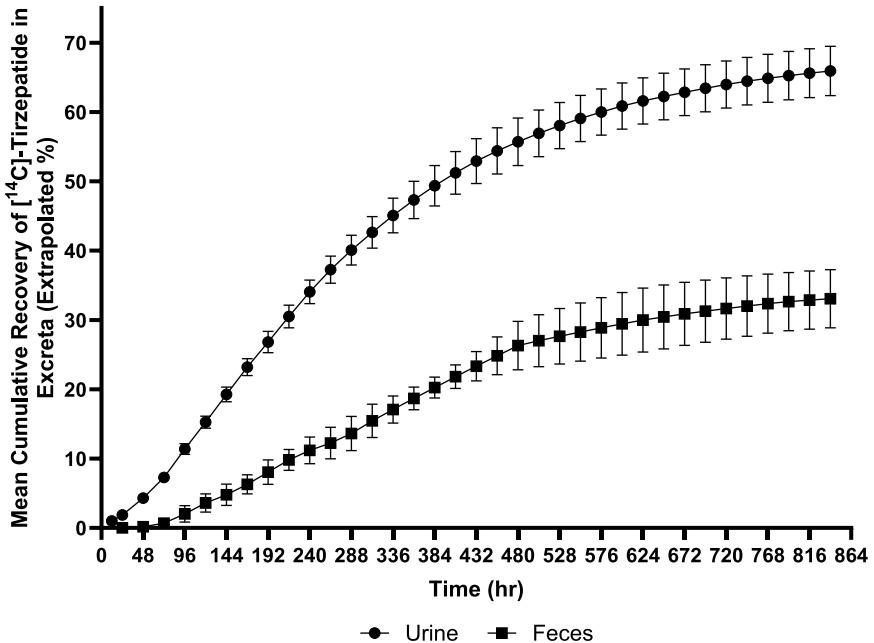
Excretion Ratio: Two to One
Slow and Safe: The entire excretion process is very slow, with most of the dose being eliminated within 480 hours (20 days). Since the labeled carbon atoms are highly stable, no radioactivity was detected in exhaled air, proving that the drug does not break down into gases, ensuring a high level of safety.
V. Insights for the General Public
Why once a week?
Because it has a stable structure and is broken down very slowly in the body, ensuring a long-lasting effect.
Does it damage the kidneys or the liver?
Neither. The kidneys serve only as an “excretion pathway”; the drug is broken down by various enzymes throughout the body and then excreted primarily by the kidneys and, to a lesser extent, by the liver (via bile into feces). As long as kidney and liver function are generally normal, this drug has a very high safety profile.
How long does it take for the drug to be completely metabolized after discontinuation?
Based on its half-life, it takes approximately 25–30 days (about five half-lives) after discontinuation for the drug to be almost completely eliminated from the body.
Will it interact with other medications?
Since its elimination relies primarily on enzymes widely present throughout the body (rather than one or two specific CYP450 liver enzymes), it is highly unlikely to interact with other medications.
Summary
Tirzepatide is like a meticulously designed “secret agent”: it enters the body via subcutaneous injection, remains intact in the bloodstream to carry out its mission, then slowly distributes throughout the body, and is ultimately broken down in a precise manner before being completely eliminated through urine and feces.
Scientific progress lies within every precise cycle of “absorption, distribution, metabolism, and excretion.” We hope this article helps you gain a better understanding of this “miracle weight-loss drug” and demystify it a little.